Match the name to the part in front of you
- A stove or range combines a cooktop and oven. Its main parts include surface burners or elements, controls, the oven cavity, racks and door.
- Identify your surface type first: gas, exposed electric coils, radiant glass or induction. Each has a different arrangement of heating parts.
- Drip bowls, convection fans and warming drawers depend on the design, so your stove may have only some of these parts.
If you're pointing at a piece and trying to name it, we'd begin with the cooking surface because gas burners, exposed coils and elements beneath glass have different surrounding parts. That distinction helps you separate the part producing heat from the part supporting your pan or catching spills.
Use “stove” or “range” for the appliance that combines surface cooking with an oven. “Cooktop” and “stovetop” name the cooking surface, while a standalone cooktop has no oven component. This distinction is useful when you're describing the whole appliance versus something on top of it.
The surface and oven can also use different fuels. A dual-fuel range combines a gas cooking surface with an electric oven, so the burner arrangement on top identifies the surface's heating type, not necessarily the oven's.
Gas grates, burners and caps
The metal supports your pots sit on are grates. On a gas cooktop, they hold cookware above the flame at the intended height for burner performance. They're commonly made of cast iron or another heat-safe metal.
Below the grates are the burners and burner caps. The gas burner provides the open flame that heats your cookware, while the cap covers the burner to protect it from spills. The support, heat source and protective cover are separate components with separate jobs.
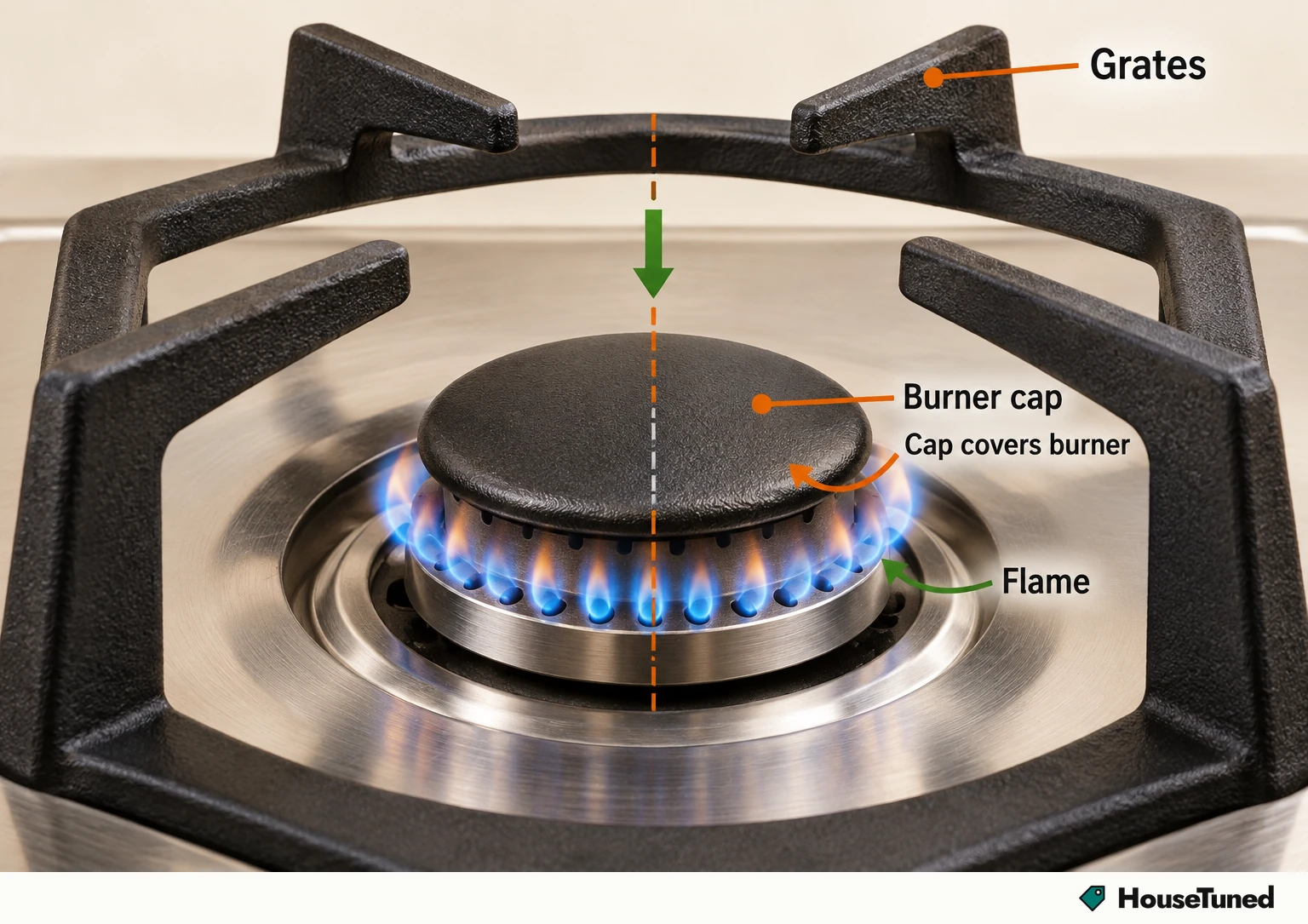
Grates and burner caps are removable parts, but “grate” names the cookware support and “cap” names the cover over the burner. When you're describing something in this area, its position above the flame or over the burner helps distinguish the two.
Electric coils, radiant elements and induction
An exposed metal coil is an electric heating element. Another electric configuration has a smooth ceramic-glass surface with radiant heating elements underneath. Both are electric cooking surfaces, but only one has an exposed coil you can see directly.
Induction uses electromagnetic heating elements beneath a glass plate. Electric and induction cooktops don't have gas-style grates. On a smooth-top electric stove, the glass itself provides a stable surface for your cookware, with the heating components below it.
The word “burner” can be confusing across these designs. Whirlpool uses it for heat sources across cooktop types, while KitchenAid distinguishes electric heating elements and coils from burners. Calling yours an “electric coil,” “radiant element” or “induction element” makes the heating type clearer.
Some Whirlpool ranges have Flex Heat Dual Radiant Elements, which offer two element sizes in one. These have a six-inch inner ring for smaller cookware and a nine-inch expandable outer ring for larger cookware. The two rings are part of that equipped element's design.
The bowls below the burners
The bowl below a burner is a drip bowl, also called a drip pan. It catches spills, leaks and splatters to protect the burner area from cooking messes. On an exposed-coil electric surface, the heating coil and the bowl beneath it are distinct parts.
Glass-top stoves typically don't have drip bowls. Their smooth surface covers the heating elements, giving you a different arrangement from a coil with a bowl underneath. That's why a list of stove parts can include drip pans even when your own cooking surface has none.
Knobs and the control panel
Look toward the front of the range or its backguard for the control panel. This group of controls handles functions such as oven temperature, baking settings, the timer and oven light. The location and layout depend on your range's design.
Knobs control the heat of the gas burners or electric elements on your stovetop. Depending on the design, they can sit on the cooking surface, along the front or at the back beside the control panel. Their location can change while their surface-control job stays the same.
Some cooktops have touch buttons instead of knobs. A range's control panel can also include a digital clock and a control lock, so some of the controls you see serve timing, lighting or locking functions rather than setting a cooking temperature.
The oven cavity, racks and door
The enclosed cooking space is the oven cavity, where baking, roasting and broiling take place. Inside it, the oven racks are metal shelves that hold baking trays, pans, pie plates and other oven cookware. “Cavity” names the space; “rack” names the shelf within it.
Most ovens have multiple racks that slide in and out. Their adjustable design accommodates multiple dishes or larger pans, which explains why the oven interior has more than one possible shelf arrangement. The rack itself is the cookware support.
The door gives you access to the food inside. Most oven doors have a viewing window, and an interior oven light helps you monitor food without opening the door. The window and light let you see into the enclosed cooking space.
The upper heating element and rear fan
A heating element near the top of the oven cavity is typically the broiler, also called the broil element. It directs intense heat toward the top of the food. That name identifies a particular heating component within the larger oven cavity.
If your oven has convection cooking, you'll likely find a fan at the back of the cavity. It moves hot air throughout the oven to help maintain even temperatures across multiple racks. The rear fan belongs to the oven's air-circulation system and is a feature of convection-equipped designs.
Temperature control and the oven vent
The thermostat detects and regulates the temperature inside the oven. Some thermostats work with the control panel to display a temperature reading. This connects the component managing oven temperature with the information you see on the display.
The oven vent is a small opening in the stove that lets heat and moisture escape, supporting air circulation and heat distribution through the oven. Keep the vent clear so air can circulate properly and the cooking process isn't affected.
What the bottom drawer is for
A warming drawer is typically at the bottom of a range and has its own temperature control. Its job is to keep cooked food warm before serving. Some drawers also have baking or proofing functions, including helping yeasted dough rise.
On some Whirlpool ranges, Keep Warm is a setting inside the oven itself. That feature keeps meals warm in the oven cavity, while a warming drawer is a separate compartment below. The feature name and the drawer name refer to different locations.
Other oven drawers are simply storage drawers. If you're unsure which type you have, check your owner's manual to identify its purpose before treating it as a warming or proofing compartment.
More in this category