Choose a kit that fits your next decision
- Start with a short-term laboratory kit, or hire a qualified radon tester.
- Follow your kit's placement and timing instructions, then return it for analysis.
- An elevated first result calls for confirmation. The follow-up result determines when to contact a radon reduction professional.
If you've never measured your home's radon, we'd start with a short-term laboratory kit because it gives you an initial screening result without committing to months of sampling. You can't see or smell radon, and a neighbor's low reading doesn't tell you what you'll find in your own home.
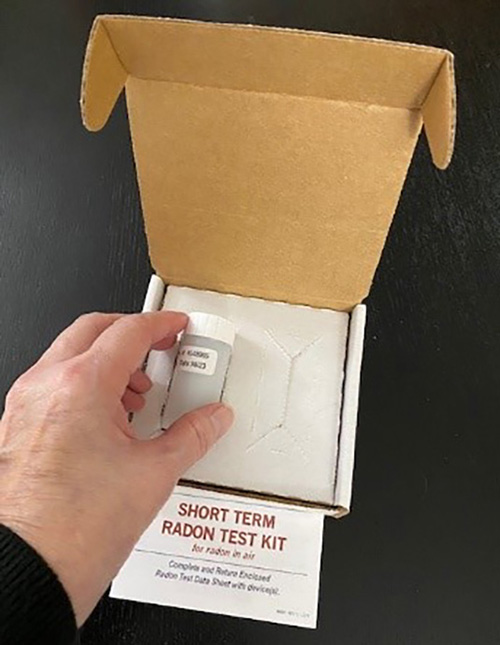
You can buy a DIY kit at a hardware store or online. Ask your state radon office about free or discounted kits first, and check whether the purchase includes laboratory fees and return postage, since those aren't always included.
CDC defines short-term testing as 2 to 90 days. Wisconsin's initial screening guidance describes a typical two-to-four-day test, while Michigan describes typical screening periods of two to seven days. Those ranges describe different devices; your kit's instructions set its actual exposure time.
Long-term kits measure for more than 90 days and help estimate your home's year-round average. They're useful when you want a fuller picture of exposure: longer measurements better reflect your home's radon levels and how you live there.
A consumer monitor has limits
For a mitigation decision, choose an NRPP- or NRSB-approved device or hire a radon contractor. Wisconsin's guidance excludes consumer digital monitors from both mitigation decisions and real-estate testing.
The distinction matters because most consumer digital monitors aren't approved by those programs: they can't be calibrated and don't follow certain quality assurance and quality control protocols. Some have shown good accuracy in research, while others have shown accuracy problems.
If your consumer monitor shows a high reading, follow up with an approved short-term charcoal kit or a long-term kit. Professional continuous radon monitors are a different option: Michigan describes them as requiring annual calibration and certification, with a trained operator.
If you're buying or selling a home, hire a qualified tester, as EPA recommends. Your state radon office can provide a list of testers; use that route for transaction testing instead of applying the household kit procedure below.
Get the house ready before opening the kit
Pick a stretch when you can keep the house closed for the required period. You can test in any season if you can maintain closed-house conditions, though winter can make that easier.
- Close exterior windows and doors at least 12 hours before starting, and keep them closed during the test except for normal entry and exit.
- Run your heating and air conditioning normally.
- For Michigan's short-term testing conditions, keep attic fans and kitchen and bathroom fans off.
Postpone a short-term test during severe or unusually windy weather, because weather can affect indoor radon levels. Closed-house testing still allows your household to come and go normally.
Find a room and a spot that meet the rules
Read your kit's instructions before choosing the spot. Use a room where you spend time on the lowest livable level, such as a bedroom, living room, den or recreation room; in a multi-unit building, CDC specifies the lowest level within your own unit.
Wisconsin's household placement rule is the lowest level where you spend at least seven hours a week. Transaction testing has a different placement rule there, using the home's lowest level, such as the basement, which is another reason to leave that test to a qualified tester.
Avoid kitchens, bathrooms, laundry rooms, closets, utility rooms and crawlspaces. Keep the device out of high humidity and direct sunlight, and choose somewhere it won't be disturbed while sampling.
Placement heights differ across the guidance. CDC specifies three feet off the ground in the middle of the room. Wisconsin's charcoal-kit placement is two to seven feet above the floor, on a table or surface at least three feet from exterior doors, windows or air vents.
Michigan specifies at least 20 inches above the floor, preferably three to six feet in the breathing zone. It also requires at least three feet from windows, exterior doors and other openings in foundation floors or walls, at least 12 inches from exterior walls, and at least four inches from other objects.
Keep those instructions tied to the kit and testing guidance you're following, rather than treating the different heights as one universal specification. If you need help choosing a location, your state radon office can help with local testing guidance.
Start the charcoal test and record the time
Charcoal tests come in several forms, including canisters, vials and paper pouches. The opening and orientation steps here apply to the bagged, paper-sided charcoal kit described in Wisconsin's short-term testing instructions (opens in a new tab); follow your own kit's directions for its design.
- Remove the charcoal test from its plastic bag. That starts the exposure period.
- Fill out the supplied form and record the start date and time, so the beginning of the sample is documented.
- Set the test at your chosen location on a flat surface, with its paper side facing upward.
- Set a reminder for the stopping time required by your kit, so you have a reminder ready before leaving it to sample.
Wisconsin describes a typical exposure of 48 to 96 hours for this procedure. Leave the kit in place for its instructed period and stop within that window: exposing it for too long or too little time makes the test invalid.
Seal it and send it to the laboratory
At the end of the exposure period, complete the remaining form fields and record the end date and time. The return package needs the completed paperwork as well as the test itself.
Seal the radon test as directed, include the form and any required laboratory payment, and use the destination printed on your kit's packaging. Follow its return instructions for that specific device.
Mail it as soon as possible. Wisconsin notes that most laboratories must receive the kit within 10 days after testing stops, including shipping time, so use your laboratory's deadline when planning the return.
Use the result to choose your next move
Look for the result in pCi/L, which means picocuries per liter of air. There is no known safe radon level; the goal is to reduce exposure and the associated lung-cancer risk.
For a first short-term result of 4 pCi/L or higher, Wisconsin calls for a second test, either short-term or long-term. If that first result is above 8 pCi/L, use a short-term test for confirmation.
A long-term follow-up gives you a better estimate of annual exposure, while another short-term test gives you a quicker result. If you use two short-term tests, calculate their average by adding the two results and dividing by two.
Contact a licensed radon reduction professional if the average of two short-term tests is at or above 4 pCi/L, or if any long-term test is at or above 4 pCi/L. This is CDC's inclusive threshold, so a result of exactly 4 belongs in that action group.
Wisconsin's mitigation wording uses an average greater than 4 pCi/L, while CDC includes 4 itself. We'd follow CDC's inclusive threshold for the professional handoff because it explicitly covers that boundary result.
Between 2 and 4 pCi/L, consider installing a radon reduction system. That lower band is still an opportunity to reduce exposure; the action threshold isn't a dividing line between safe and unsafe air.
Find qualified help for the next step
Ask your state radon program for qualified measurement or mitigation professionals. EPA's kit and professional finder (opens in a new tab) provides routes to those resources.
For states receiving federal indoor-radon grants, EPA requires public provider lists to include professionals credentialed through a state process, such as state licensing, or a recognized national proficiency program. The two national programs are the National Radon Proficiency Program, or NRPP, and the National Radon Safety Board, or NRSB.
In Wisconsin, regional Radon Information Centers also answer testing questions and provide kits, with many offering free or reduced-cost kits and laboratory fees often covered. You can reach radon help there at 1-888-569-7236.
Put the next test on your calendar
After a radon reduction system is installed, retest a few months later to see whether levels were reduced. That follow-up measurement gives you the result of the work in your own home.
Test before you begin spending more time on a lower level, such as using a basement as a bedroom or home office. Before a major structural renovation, test the area you'll change, then test again after the work because renovations can change radon levels.
Wisconsin recommends repeat testing every two to five years in case levels change. It also calls for testing after major work affecting the foundation, heating or cooling, and after weatherization projects such as replacing windows and doors.
More in this category