Ice on the coils means they ran too cold
- The coils ice when they get too cold, from a cool room, a clogged filter, blocked vents or a humidity target set too low.
- Switch it off, unplug it and let all the ice melt on its own. No hair dryer, heater or sharp tool.
- Then clean the filter, clear space around the unit and check the room temperature against your model's manual.
- A thin coat of frost right after switch-on can be normal. Heavy ice that keeps coming back after those checks needs professional service.
A thin glaze that shows up right after you switch on is a different animal from a solid white block that keeps returning. We'd unplug it and let it thaw completely before checking anything else, because a restart should only come after a full defrost and the filter check happens with the unit unplugged anyway.
Everything here applies to portable room units, the kind you can move from room to room. Whole-home dehumidifiers that run through your air ducts are often permanent installs and a different job.
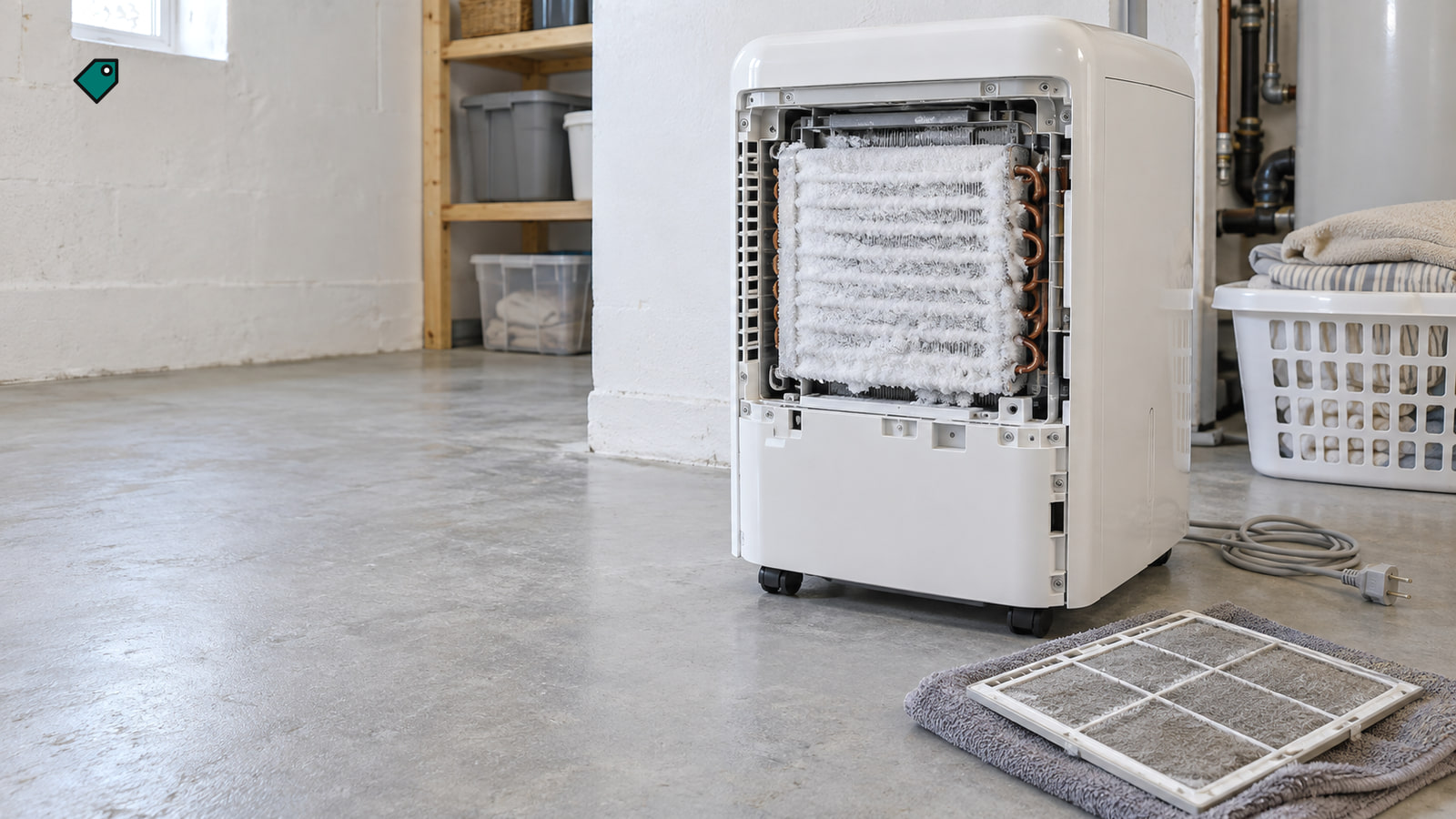
What makes the coils ice over
The cold coil inside runs close to freezing even when everything's fine, so anything that makes it colder or starves it of air can tip it into frost.
- A dirty or clogged filter. Less air moving across the coil lets it get too cold.
- Blocked airflow from objects sitting too close to the front or back of the unit.
- A humidity target set too low, so the machine keeps trying to pull too much moisture out and overworks itself.
- A room that's too cool. Most dehumidifiers work best in warmer rooms, and the coils are more likely to freeze once the air drops below about 65°F.
Restricted airflow also keeps ice that's already there from melting, which is why a blocked unit can stay frozen.
Inside the machine, a system that's out of balance can also drive coil temperatures down. That one is for a technician, which is why the outside checks come first.
The giveaways are frost or ice on the metal coils behind the front grille or filter, and a bucket collecting little or no water even though the unit is running.
Light frost or a real ice problem
| What you see | What it means | What to do |
|---|---|---|
| Light frost on the coils during normal running | It can form under certain normal operating conditions | Make sure the filter is clean and the unit has room around it |
| Heavy frost or solid ice | Something is making the coil too cold or keeping the ice from melting | Switch off, unplug and thaw it fully |
Some units watch for frost themselves. On some models a sensor on the coil detects frost and shuts off the compressor so the coil warms and melts it, and others have an anti-frost sensor that turns the whole unit off when the air temperature drops below a certain point.
When frost builds faster than that can clear it, the compressor can end up cycling on and off without pulling any moisture from the air. That's your cue to switch it off and defrost it before it runs again.
Thaw it out, then clean the filter
Heavy ice means the machine isn't doing its job. On a TCL unit, ice on the coils usually means it can't remove moisture properly. It isn't normally dangerous, but the dehumidifier isn't working as it should.
- Press the power button to switch the dehumidifier off.
- Unplug it from the wall so it has no power at all.
- If your model lets you open the front or grille area easily, open it just enough to see the coils.
- Lay a towel under or around the unit to catch any extra water that drips as the ice melts.
- Leave it off until all the ice has melted and the coils look clear and wet, not frosty.
While it's still unplugged, check the filter and clean it if it needs it, since a clogged filter cuts the airflow that keeps the coil from getting too cold.
On most TCL dehumidifiers, the filter sits behind the front grille or air intake. On those units, pull it out, rinse it gently in lukewarm water until the dust is gone, shake off the extra water and let it air-dry completely before you reinstall it securely.
If the filter is torn, damaged or won't come clean, it may need replacing.
Space around it and how cold the room gets
Move furniture, boxes and curtains away from the front and back of the dehumidifier, and don't put anything on top that blocks the vents.
How much space you need depends on the machine. Some units ask for at least several inches on every side. On GE units, allow at least 18 inches all around and keep the room's doors and windows closed.
Most portable units blow air out the top and can sit against a wall. If yours doesn't discharge from the top, keep it away from walls and furniture so air can circulate freely around it, and keep it clear of dusty spots like a woodworking area, since dust and dirt can clog the coils and grilles.
Temperature is the other half. Below about 65°F, frost forms on the coils more easily. Some units also have a firm lower limit: on Frigidaire units it's 41°F, and on GE units the coils may freeze below 41°F and need defrosting as often as once an hour. Frost controls on current GE models shut the unit off before a major freeze-up, but they don't stop freezing altogether.
Some models offer low-temperature operation and run below 41°F without the coil icing up, so check your owner's manual for your model's exact temperature limits.
If the room is cold, move the dehumidifier somewhere warmer or run it when the room warms up. Avoid running it for long stretches in unheated basements, garages or very cool rooms.
If the space you're drying typically falls below 65°F, consider a model specified for lower temperatures. You can compare ENERGY STAR certified portable models (opens in a new tab) when you shop.
Restarting it and watching for ice
Wait until the unit has fully defrosted and the filter is clean and back in before you power up.
- Plug it into a properly grounded outlet. If you use a drain hose, keep it away from cords and connections, and never run drainage near electrical circuits or devices.
- Turn it on and set the humidity to a moderate level, not the driest or lowest setting.
- Check the display for any error code, and look it up in your use and care manual if one shows.
On TCL units, a reasonable target is around 45 to 55%. On Frigidaire units, if the setpoint reads CO, change it to a number in the 35 to 85 range.
An extremely low target makes the unit run more often and more likely to ice up in cooler conditions.
If the coils ice up again even after a full defrost, a clean filter, cleared space, a room that isn't too cold and a new humidity setting, stop the home checks. There may be an internal issue that needs professional service.
On a TCL unit, reach TCL support (opens in a new tab) with the model and serial number, where the ice forms and how often, any error codes or lights, and the checks you've already tried.
Jot these down before you call.
Tick what applies and add details; the note above fills in as you go.
Once it's running again, a light coat of frost right after switch-on is normal on GE units and should clear within 30 to 60 minutes under normal conditions. In a very humid room, a GE unit may run nonstop for three or four days before it reaches and holds the dryness you set, so give the bucket time to catch up.
More in this category