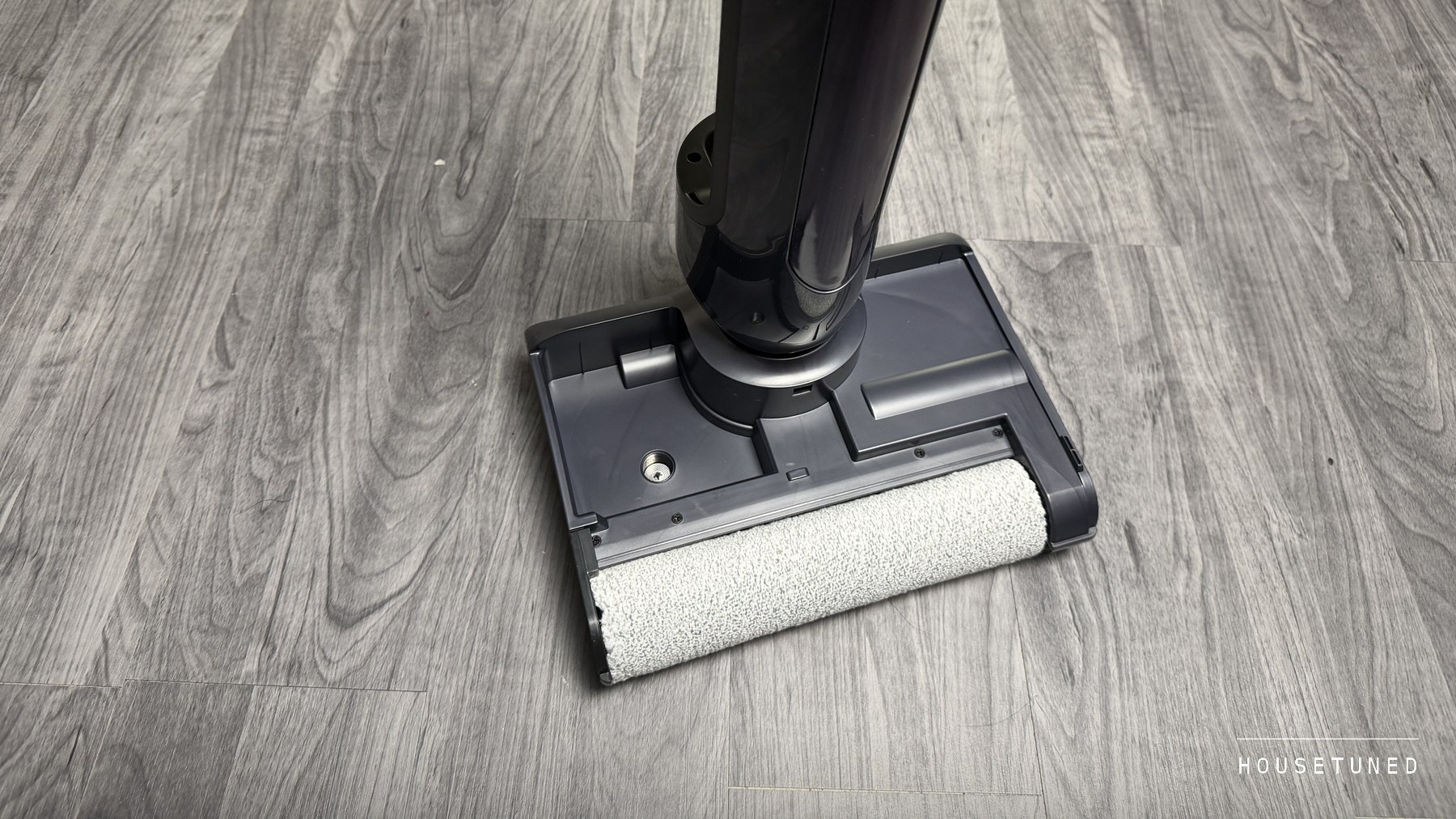
A Floor Cleaner You Grab, Not One You Schedule
Most floor cleaning runs to a timetable. The robot goes out while everyone is at work, and the mop comes out on Saturday. The messes that decide whether a kitchen feels clean keep no timetable at all: a cereal bowl on its side at breakfast, grit walked in from the back door, a sticky patch by the fridge you only find in socks. A cordless floor washer is for that gap, and it earns its space only if grabbing it beats grabbing the paper towels.
For about two weeks in August the AC1 TriFlex was our daily floor tool across tile, laminate and hardwood, taking the usual dust, crumbs and pet hair and more than a few spills. It vacuums and washes in the same stroke through a damp roller, sends solids and dirty water to a tank on its body, and stands in a dock where it charges and, at the press of a button, rinses itself.
- Tested
- Daily for about two weeks, August 2026
- Floors
- Tile, laminate and hardwood
- Clean water tank
- 800 ml, water below 30°C (86°F)
- Standing water
- No deeper than 5 mm, per Ultenic's manual
- Runtime
- 55 to 60 minutes, by Ultenic's own figures
- Full recharge
- About 4 hours at room temperature
- Weight
- About 8 pounds
- Warranty
- 1 year in the US, 2 years in Europe
So this review sorts messes rather than features: which ones it clears in a pass, which still start with a towel, and what it asks of you afterwards. Where we lean on Ultenic's manual rather than our own testing, we say so.
The Messes It Clears in a Single Pass
The dry mess a household drops or tracks in every day, from cereal and crumbs to grit and pet hair, went in one pass, and because the roller runs damp, the floor was washed on the same stroke and dried quickly, leaving tile and laminate streak-free. A tipped breakfast bowl stopped being a job for a broom, paper towels and a mop, as the flakes, the milk and the tacky film underneath all went with the one machine.
Patches that had dried sticky occasionally took a second pass, and the roller got through them without anyone pressing down. We left it in Smart, the mode it starts in, for nearly everything. What it collects goes to one tank, where a separator keeps solids apart from water, so emptying it means tipping the debris into the bin and pouring the water away, not fishing through sludge.
The handling is why we kept picking it up. At about 8 pounds it is light for a floor washer, and it drives itself forward and backward, so your arm only guides it while the swivelling head gets round chair legs and door frames. We did whole-house cleans without wanting to put it down, carried it between floors in one hand and, unusually for a floor cleaner, enjoyed using it.
Where the Towel Still Goes First
Standing liquid is the one mess that kept sending us back for a towel. The listing promises liquid spills and dry debris in one step, and small spills with bits of food in them did come up cleanly. On a real puddle, though, the head took some water on the first touch and shoved a fair share forward, so a bigger spill covered more floor before the machine had it all. It did the same in every mode, including Water Suction, which only picks water up, and Max, which Ultenic's manual recommends for water accumulation.
The fix was technique. Drawing the head slowly back toward us in overlapping strokes, never shoving it into the spill, let it gather the water instead of pushing it along. Past the size of a knocked-over glass, a towel took the bulk first and the machine did the washing after, which left the floor fully dry.
Ultenic draws its own line in the manual: do not use the machine where water is deeper than 5 mm, about a fifth of an inch. Our rule of thumb was about volume rather than depth. Up to a knocked-over glass, the machine and a slow hand. Beyond that, a towel first.
Grease, Soy Sauce and the Wrong Soap
The kitchen is where most spills happen, and where Ultenic's manual is most specific. Start with heat. The clean tank takes water below 30°C (86°F), and nothing in Ultenic's documents mentions heating it, so grease gets a cool wash. After heavy oil, Ultenic suggests repeating the self-clean or soaking the roller in warm water, then drying it completely. Our testing did not include a greasy floor, so we cannot vouch for it beside a busy stove.
Soy sauce is an odd thing to find in a manual, and a useful one. Ultenic lists iron-containing liquids such as soy sauce among the causes of a false tank-full warning, because they can upset the dirty tank's level sensor. If it announces a full tank after a kitchen spill and the tank plainly is not full, a thorough clean of the tank and its cover is the fix.
Soap is the third. The manual allows only Ultenic's recommended solution, measured at one capful, and warns off household cleaners that foam, since foam is another route to the same false warning. The Amazon listing says any cleaning solution will do. Go with the manual, starting with the bottle in the box.
Flat Under the Sofa, Tight to the Baseboard
Of all its features, lying flat did the most to change how we cleaned. Lay the handle down and the head keeps going under the sofa, the beds and low cabinets, with nobody on their knees and no furniture moved, so the dust that used to sit permanently under things joined the everyday route. The edges are handled just as well. The roller runs close to the side of the head, and it hugged baseboards and corners tightly enough that we never needed a second tool.
The manual adds one condition that is easy to miss. The dirty tank rides on the body, and before lying the machine flat Ultenic says to check it and empty it if the water has reached the maximum line. In ordinary use it recommends keeping the tilt under 140 degrees, saving the full 180 for reaching under things.
Check the Floor Before It Gets Wet
Ultenic limits the machine to indoor, non-carpeted floors such as vinyl, tile and sealed wood, and warns against running it over loose objects or carpet edges. Tile, laminate and hardwood were all fine in our testing, but wood deserves a minute of checking first, because excess water is what damages it.
The National Wood Flooring Association's advice is never to leave a wood floor wet and to use a damp mop rather than a soaking one, because excess water gets into the seams. A washer whose trail dries fast, as this one's did, fits that advice while the finish is intact. To check yours, the Hardwood Manufacturers Association suggests pouring a tablespoon or two of water on a well-walked spot. If it beads up and wipes away without a trace, the finish is doing its job.
- Try the water test on the busiest stretch of wood. If the water soaks in or darkens the boards, keep the washer off that floor.
- Move rugs and runners out of the way. It is a hard-floor machine and should not ride over carpet edges.
Empty, Wash, Empty Again
Wet cleaners go sour when their upkeep is a nuisance, so the rinse matters almost as much as the suction. This one runs from the dock: one button on top of the handle, roughly two minutes, and the roller and its pipes are washed through. The manual wants the clean tank above its minimum line and the dirty tank empty before you start, then the dirty tank emptied again and the roller and HEPA filter left to air-dry. Ultenic lists no drying function.
Make the rinse part of putting it away. Empty the tank, press the button, empty it again, and let the roller dry before the next mess. Ultenic's manual asks for the dirty tank to be emptied promptly to keep odours away.
The anti-tangle comb held up its end. In two weeks with plenty of hair on the floors, not one wrap needed cutting off the roller. If something does wind round it, the machine says the roller needs cleaning and stops, and the same voice prompts call out a full dirty tank or a low clean one as you go, while a small display shows the mode and battery.
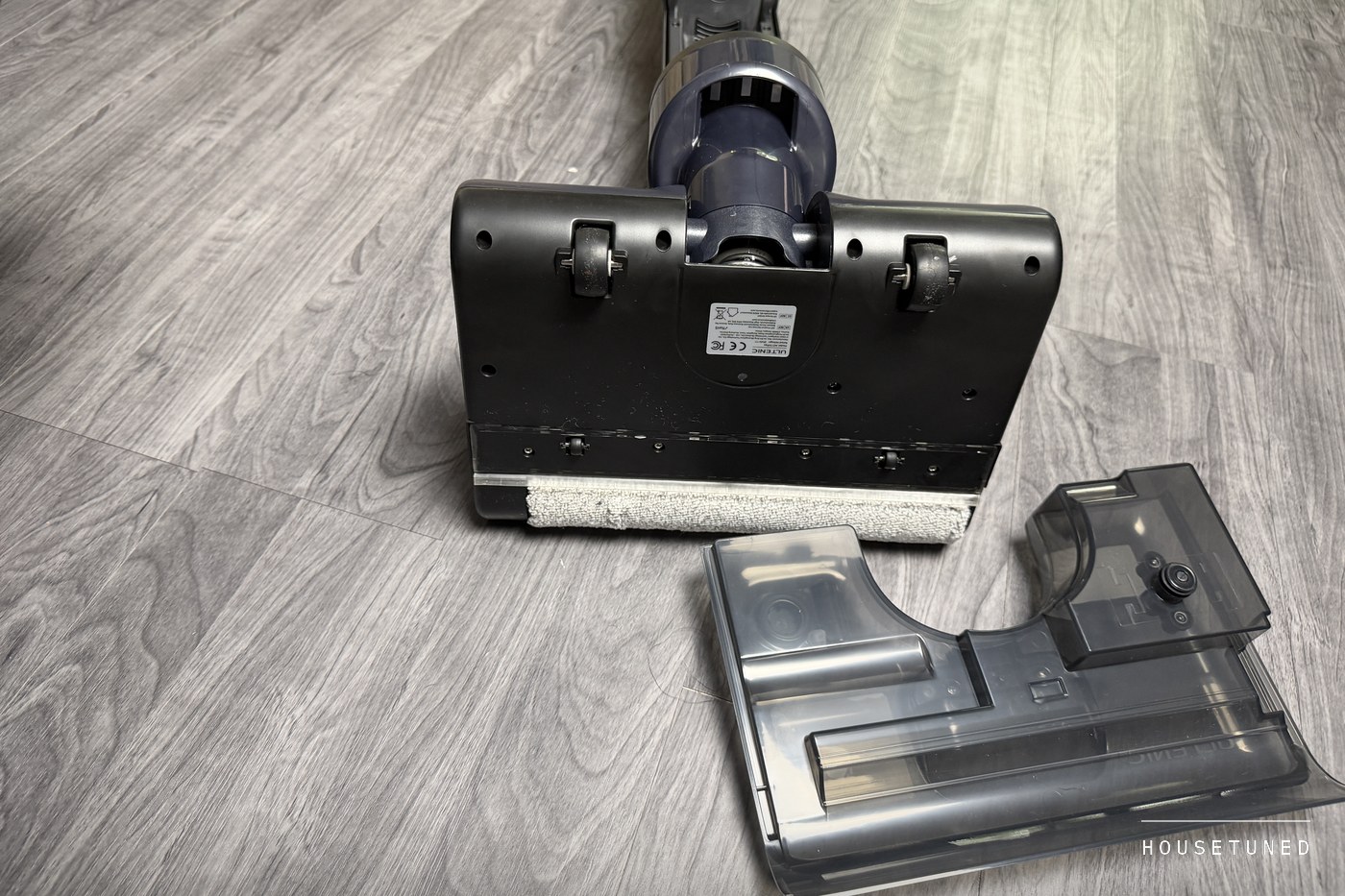
The manual also wants the dirty tank rinsed after every use, and now and then a deeper clean: wash and air-dry the sponge from the tank's cover separately, scrub the tank walls with the included brush, and wipe the suction inlet with a cloth instead of rinsing the floor head. Never soak the cover or hold it under running water. If water gets inside, Ultenic says to shake it out and dry it in the sun for 24 hours.
A Four Hour Recharge, and Where It Lives
Runtime was never the limit. Ultenic's store rates it at 55 minutes and its Amazon listing at up to 60, and one charge covered a full clean of a typical home with room to spare. Water Suction used the least battery, Max the most, and Smart, our everyday setting, sat comfortably between.
The recharge is what we complained about. Ultenic puts a full charge at four hours at room temperature, so you cannot run it flat, give it half an hour and go again. Cleaning every day or two, that never mattered: it went back on the dock after each use, was always ready and held its charge well between sessions. A whole-house deep clean with a second job planned for later needs a full battery at the start.
Where it lives matters. Ours stood in its dock in plain sight and nobody in the house objected. The manual wants it upright in the dock close to the wall so nobody trips on it, and kept in a dry room between 4°C and 35°C (39°F to 95°F) whether in use, charging or stored. That can rule out a garage or shed for part of the year. If it will sit unused for months, Ultenic asks for a three-hour charge every three months.
What It Adds if a Robot Already Mops
A robot and a floor washer divide the floor by time rather than by room. The robot does the scheduled pass while the house is empty, the washer the unscheduled one, minutes after the mess. The Narwal Freo 20 Edge robot we reviewed comes with firm rules against standing water, urine and pet waste. This machine has its own limits, but the spill with debris in it, the sticky patch somebody just trod in and the grit at the back door are exactly its work.
If your robot vacuums but does not mop, this replaces the mop and bucket outright. It cannot replace the robot, because it is a machine you steer, and it is the wrong buy for a mostly carpeted house. If big liquid spills are why you are shopping, remember where the towel goes.
The Score, and What Would Raise It
For the messes it was built for, this is the best floor washer we have used. It is light enough to grab without thinking, pushes itself, reaches flat under the furniture and tight along the edges, and the rinse cycle and comb take away the grim part of owning a wet cleaner. Over two weeks it got our floors cleaned more often, simply because grabbing it was easier than putting it off.
It scores 8.5 rather than higher for three reasons. Standing liquid, which a wet dry vacuum should handle best, is where it needs a slow hand or a towel, and Ultenic's own manual stops at 5 mm of water. The four hour recharge makes two big cleans in a day a planning exercise. And a machine with a pump, a drive belt and a battery comes with one year of cover in the US. Better pickup on puddles would move the score most.
A hard-floor home where small messes happen every day. Keep a towel for the big spills, check your wood first, and let it live on its dock where you can see it.
Can it clean up after a pet accident?
We did not test one, and Ultenic's manual neither approves nor rules it out. We would bag anything solid and blot the rest with paper towels before the machine touched it, then empty and rinse the dirty tank straight away.
Does it work as a dry vacuum?
Not really. It washes as it vacuums, and its three modes are Smart, Max and Water Suction, the last meant for picking up water. For rugs or a purely dry clean, it sits alongside a conventional vacuum rather than replacing one.
Is the warranty two years?
Only in Europe. Ultenic covers US purchases for one year, in the country where you bought it, and excludes normal wear and tear. Replacement rollers and HEPA filters are sold as spares.
More in this category