Check the operating conditions first
- An off ice maker, restricted water supply, warm freezer or filter problem can stop or reduce ice production.
- Check your model's ice maker control first. If the trouble began after a filter change, check that installation next.
- Once the basic checks are addressed, try the reset that fits your refrigerator.
An empty bin can have you hunting for a reset button before you've checked whether the ice maker is enabled. We'd check the control first because accidentally turning it off is a common cause, and the right on/off action depends on your refrigerator's design.
If nothing changed recently, work through the control, water supply, freezer setting and filter in that order. That puts the operating settings and existing supply ahead of a reset, which Whirlpool describes as something that sometimes resolves minor issues.
Your arm, switch or display determines the next move
Match the control to your refrigerator's model manual before operating it. The switch or button is typically on the ice maker or inside the refrigerator compartment, but Whirlpool uses several designs. If you need the manual, search your model number on Whirlpool's Manuals and Literature website, as directed in its ice maker control guidance (opens in a new tab).
For a wire shutoff arm, lower the arm to turn the ice maker on and lift it to turn it off. On the covered-arm version, lift open the ice maker door before lowering the arm. Check which version you have so you can reach the actual control.
A raised wire arm can also be the normal full-bin shutoff. As cubes accumulate in the storage bin, they raise the arm to the off position and stop production automatically. Look at the amount of ice beneath the arm when interpreting its position.
For the design with an I/O switch on the right of the ice maker, select I for On or O for Off. Other designs put the switch at the bottom of the ice maker, reached by lifting its door, or on the left wall of the freezer door, accessible only with the ice storage bin removed.
For a digital display, use your model's instructions to identify the ice maker setting. To disable it through the display, access the settings menu and follow the on-screen instructions. Keep the model manual beside you for the specific controls your refrigerator uses.
A restricted supply can leave the ice maker without water
Check that the existing water line is securely connected and the supply valve is fully open. A restricted or shut-off supply can keep the ice maker from working correctly even when its control is on. Check both the connection and valve position before moving farther through the troubleshooting.
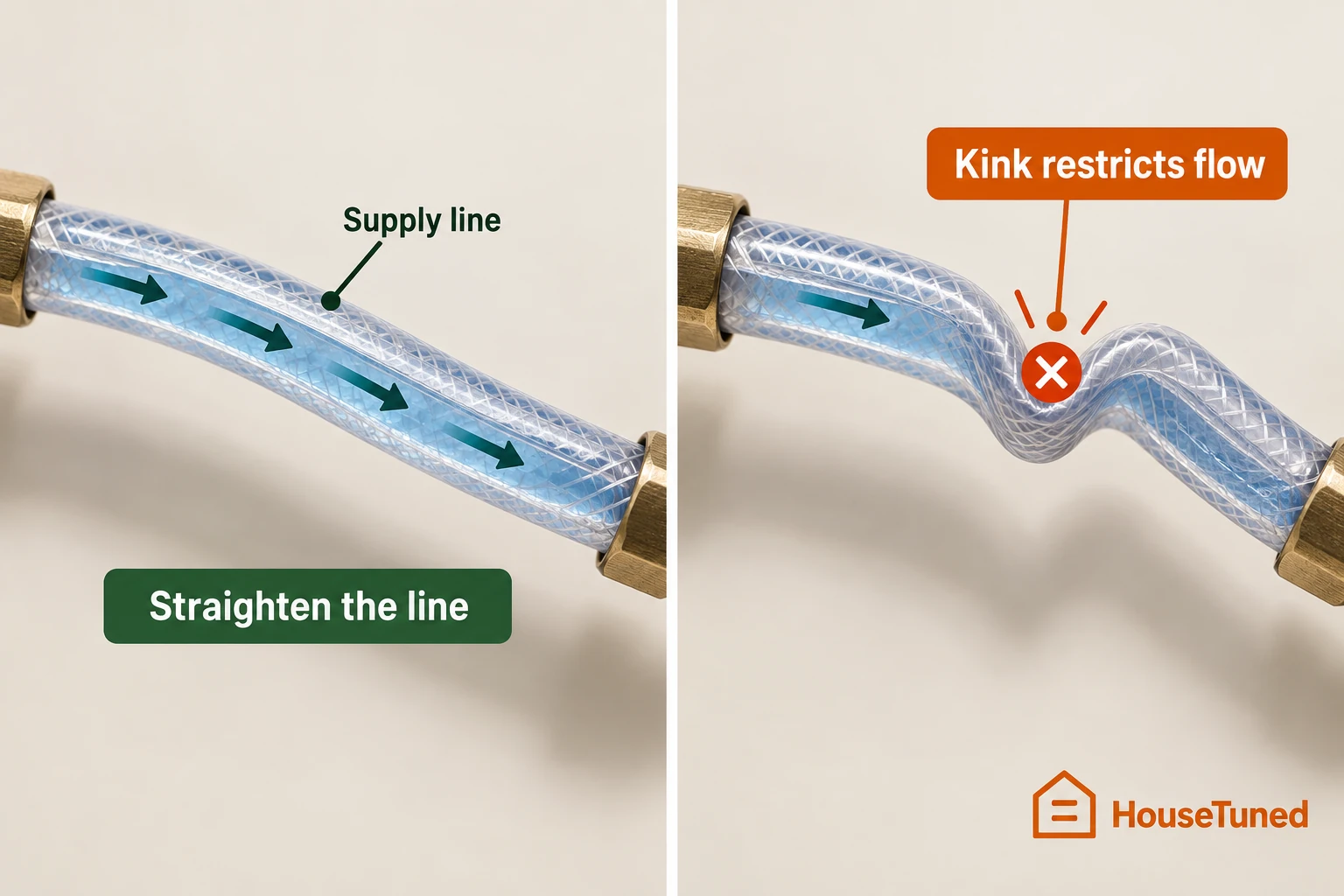
Look along the line for kinks or blockages that could hinder flow. Straighten a kinked water source line, following Whirlpool's refrigerator water-supply checks (opens in a new tab). When positioning the refrigerator afterward, don't push it so far against the wall or cabinet that it pinches the line and restricts the supply again.
For a French-door/bottom-freezer refrigerator, also confirm that the existing connection is to a cold-water supply. That is a prerequisite for the ice maker and water dispenser in Whirlpool's French-door/bottom-freezer supply guidance (opens in a new tab).
The freezer needs the right setting
Check the freezer temperature setting and adjust it if needed. Whirlpool's refrigerator troubleshooting guidance (opens in a new tab) gives a setting range of 0–5°F for ice production. A setting that's too warm can keep the ice maker from functioning properly.
The reason is in the cycle itself: water fills the mold, then freezes into cubes. A heating element gently warms the mold to release the ice into the storage bin. Getting water to the refrigerator and freezing it are separate parts of making a batch.
If the dispenser still supplies water, keep the freezer setting and ice maker control on your check list. Dispensing water doesn't complete that fill, freeze and release cycle. Continue checking the freezer setting regularly and adjust it as needed.
An older filter can reduce ice production
Look at when the filter was last changed and whether its replacement indicator is on. Whirlpool recommends replacement every six months, when the indicator light comes on, or as needed. Usage and water quality can require a change sooner, so the calendar is only part of this check.
A clogged filter can restrict water reaching both the ice maker and dispenser. Reduced ice production together with slower dispensing makes filter condition especially relevant to your checks. An improperly installed filter can produce those same flow symptoms, so consider both its age and any recent installation.
When replacement is due, select the filter intended for your refrigerator. Whirlpool recommends everydrop filters in its filter maintenance guidance (opens in a new tab). Matching the filter to the refrigerator matters alongside deciding when it's due for a change.
A fresh filter may need to be reinstalled
Check that a newly installed filter is locked in place and creating a proper seal. Incorrect installation can reduce or stop water flow, decrease ice production and cause leaks from the filter housing. A filter can therefore need attention immediately after installation, even though it hasn't had time to become overdue.
Use Whirlpool's recent-filter installation check (opens in a new tab) to connect what happens at the dispenser with your next action.
- Remove the water filter from its housing so you can try the dispenser with the filter out.
- Try dispensing some water and watch whether water comes out.
- If water dispenses, reinstall the filter. Whirlpool identifies that result as improper installation, so check that the reinstalled filter is locked in place and properly sealed.
The reset depends on your refrigerator's controls
With the basic checks addressed, identify whether your ice maker has a reset button. Consult your model manual if you're unsure which control it is. Whirlpool's reset guidance (opens in a new tab) says to press and hold that button for a few seconds.
If your refrigerator doesn't have a reset button, unplug the refrigerator for one minute, then plug it back in. This is the alternative reset method for that branch. Whirlpool describes resetting as a way to sometimes resolve minor issues.
Your French-door model makes ice but doesn't dump it
For a French-door/bottom-freezer refrigerator, distinguish an empty bin from ice that forms but stays in the ice maker. When ice is being made but isn't dumped into the bin, Whirlpool gives a specific reset and follow-up check for that situation.
Follow the French-door/bottom-freezer no-dump reset (opens in a new tab): unplug the refrigerator for one minute, then reconnect it. Wait a couple of hours before checking for ice in the bin. Ice arriving there is the result to look for, because the problem in this branch is the transfer of made ice into storage.
More in this category