Measure the compartment before changing the setting
- Put an appliance thermometer in the refrigerator compartment. For perishable food, the reading needs to stay at 40°F or below.
- If it’s warmer, find your model’s recommended setting and make a small change toward colder.
- If the temperature still won’t stay at 40°F or below after the control, airflow and placement checks, stop using the unit for perishables.
A cold drink tells you how that drink feels, but it doesn’t give you the compartment temperature. We’d measure before turning the control because few refrigerator controls show the actual temperature. That reading tells you whether a colder setting is needed and gives you a way to judge the change.
Use a freestanding appliance thermometer in the refrigerator compartment and check it regularly. For refrigerated food, 40°F is the upper limit. A useful target is 35–38°F, with about 37°F near the middle, so there’s no reason to chase the coldest control position once food is staying cold without freezing.
What a warm reading points you toward
When the thermometer reads too warm, start with the parts of the cooling setup you can change: the selected setting, the space around food and the refrigerator’s location. A warmer setting may call for a small adjustment. Packed contents can keep cold air from circulating, while nearby heat and a tight space against the wall work against cooling.
That order also helps you avoid turning the control colder to compensate for a blocked air path or a hot spot. Look at the control first, then at the food and the space outside the cabinet. Use the temperature reading to decide whether the changes have brought the compartment into the range needed for refrigerated food.
Make one small control adjustment
Find the recommended starting setting in your refrigerator’s manual. Controls differ: yours might be a dial or arrow buttons, and it might show degrees or numbered ranges. The control can be on an inside wall, along the door edge or at the top center, so use your model’s instructions to identify both its location and the colder direction.
If the measured temperature is too high, move the control a small amount toward colder. Leave it at that setting for at least 24 hours, then read the thermometer before making another change. Giving each adjustment time to settle lets you tell what that setting actually does in your refrigerator.
A garage or basement can change the setting you need as humidity or outside temperatures change. Let the compartment reading guide a small adjustment there, too. A dial number shows the position you selected; the thermometer shows the temperature your food is getting.
Protect the food while the fridge is warm
Take care of stored food while you work on a warm compartment. If you’re unsure how long its temperature has been at or above 40°F, throw the food out. A reading taken now tells you the current temperature, so use the stated time condition when deciding what to keep.
When you bring in groceries or rearrange what’s inside, refrigerate or freeze meat, poultry, eggs, seafood and other perishables within two hours of cooking or buying them. If the temperature outside is above 90°F, refrigerate them within one hour. Put food that needs chilling away within that window while you make room for air to move.
Leave room for cold air inside
Move containers away from interior air vents and leave space around refrigerated food. Cold air needs to circulate around it to keep it properly chilled. If items are pressed tightly together, rearrange them so the air paths stay open.
A stocked refrigerator can help it stay cool, but stocking it isn’t a reason to pack it tightly. Keep food in the compartment without blocking vents or crowding out circulation. That gives you the benefit of having it stocked while leaving cold air a path around what you store.
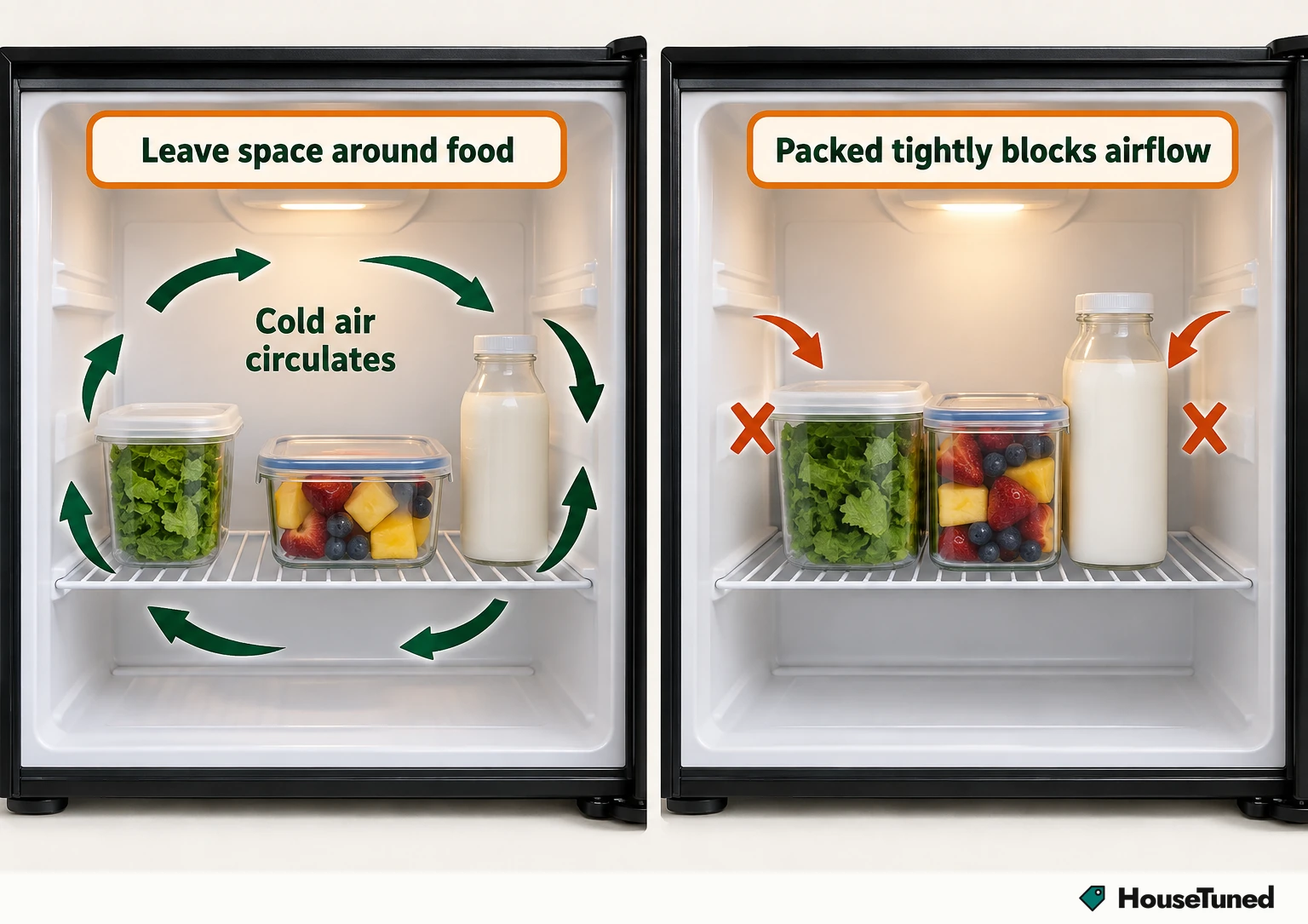
When you take something out, close the door promptly. Brief openings help the refrigerator stay cool, and minimizing door-open time gives the setting and the clear air paths a better chance to hold the measured temperature.
Give the outside a cooler spot and some space
Look at what surrounds the refrigerator. Move it away from heat-producing appliances such as an oven or dishwasher, and keep it out of direct sunlight from a window. Changing that spot can ease the cooling job without immediately asking for a colder setting.
Leave a few inches between the refrigerator and the wall. If yours is pushed close against it, give it that space. Check your own model’s installation instructions for the clearance its location requires; the general wall spacing isn’t an exact clearance for every refrigerator.
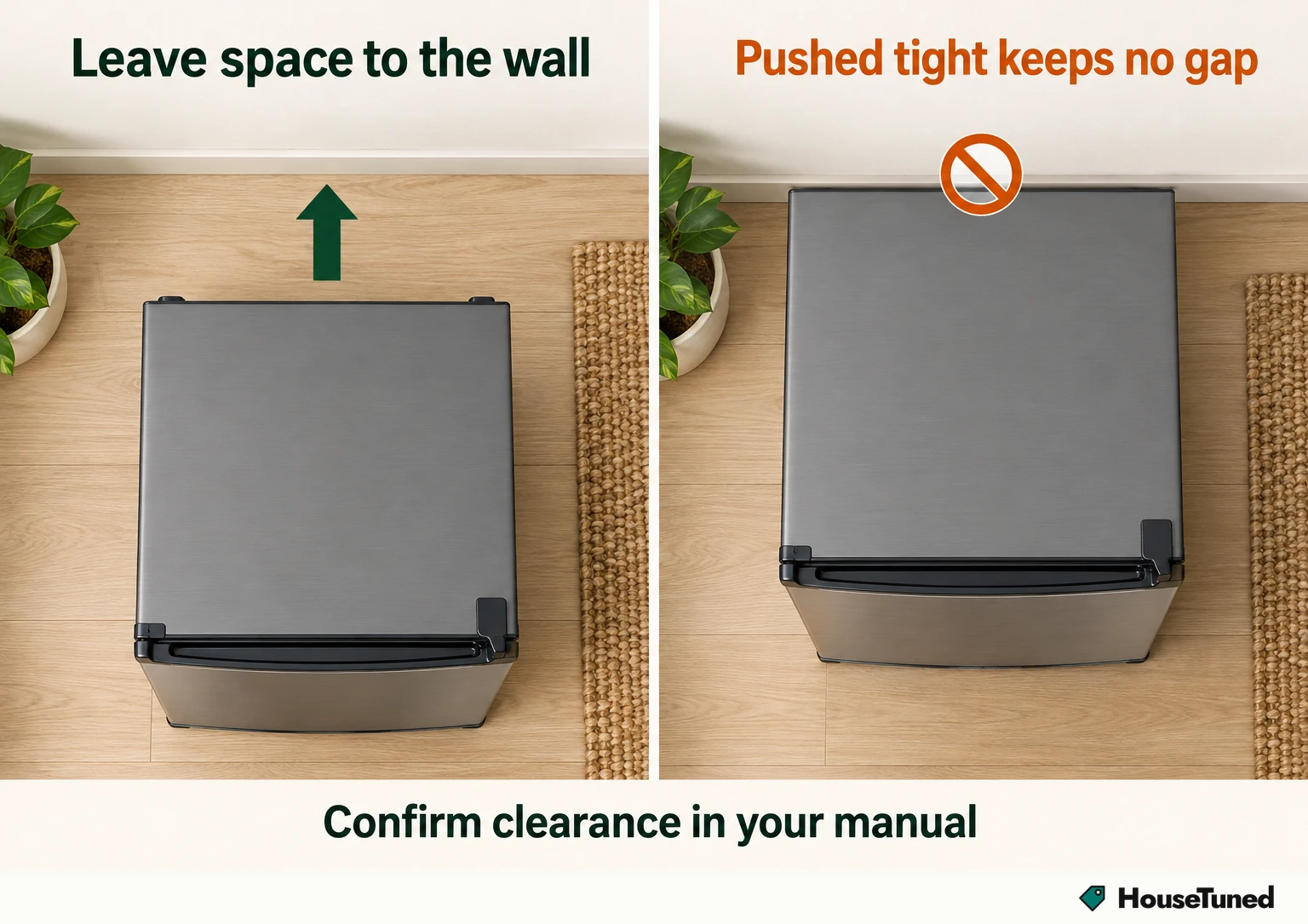
Consider the room as well as the wall. In a garage or basement, humidity and outside temperatures can affect the setting needed to keep the refrigerator cold. Once the spot and wall space are sorted, use the compartment temperature to judge the setup.
If food starts freezing
Ice on food calls for a different move from a warm reading. Temperatures below 33°F may freeze food, and cold air can settle near the bottom of an emptier refrigerator. Check the thermometer and the food before turning the control any farther toward cold.
If food is freezing, use your model’s control directions to make a small move toward warmer. Aim for a compartment that stays at 40°F or below without ice forming on the food you keep there. Cold milk or juice and fresh food that isn’t spoiling early are useful signs, but the thermometer reading decides whether the temperature is suitable.
If yours is a compact beverage cooler
If your compact unit is sold as a beverage cooler, check its manual for the appropriate temperature range. A cooler’s intended range may differ from the 35–38°F target for a refrigerator. The word “cooler” and a cool-feeling drink can’t tell you whether the compartment is cold enough for perishable food.
Use the appliance thermometer if you plan to keep perishables in it. The refrigerated-food limit is still 40°F or below, so the measured compartment temperature is the useful answer when you’re deciding what that unit can hold.
Let the final reading decide what you store
If the refrigerator still stays above 40°F after the manual-guided control change and the interior airflow and placement checks, stop using it for meat, dairy, eggs and other perishables. Check your model’s manual or contact its maker for the next step. The measured temperature means the compartment isn’t holding the limit needed for refrigerated food.
If it holds 40°F or below without freezing food, keep the setting and the clear space around the food and wall. Check the appliance thermometer regularly to make sure that result continues to hold.
More in this category
Take a closer look
Why Is My Refrigerator Not Cooling?
What Is the Proper Refrigerator Temperature?
What Is a Counter-Depth Refrigerator?
- Why Is Water Leaking Inside My Refrigerator or Freezer?
- Why Is My Samsung Refrigerator Temperature Blinking?
- Samsung Refrigerator Light Not Working
- What Should the Temperature Be Inside a Refrigerator?
- How to Organize My Refrigerator
- What Does the D90 Code Mean on an LG Dryer?
- Samsung Dishwasher LC Code but No Leak