What F21 means on your washer
- On the front loaders covered here, F21 means the washer took too long to drain.
- Look at the hose and the drain it empties into first.
- Keep a water-filled, locked door shut.
On front loaders covered by Whirlpool's F21 drain instructions (opens in a new tab) and Maytag's F21 instructions (opens in a new tab), F21 means draining took longer than the control expected. It describes a symptom, not a failed pump. Water may remain in the drum, or the tub may look empty after draining too slowly.
We'd inspect the exposed hose first because a kink can stop water without a failed part. If your washer defines F21 differently, stop this drain procedure.
- If water is visible behind a locked door, leave the door shut while the washer attempts to drain. A door that stays locked with water inside needs the drain checks below.
- Confirm that yours is a front loader whose F21 code means a drain problem. If F21 means another fault on yours, stop this drain check.
- Press Pause/Cancel if the control offers it. If the display clears, continue with the drain checks and a test cycle before washing another load.
If the washer will not drain but shows no F21 code, follow the broader washing machine drain checks.
What the water and pump sound tell you
The pump moves water through a hose to the standpipe or sink. A restriction slows that flow; excess suds can also interfere with draining and spinning.
| What you see or hear | What it suggests | First move |
|---|---|---|
| Water remains and the pump hums | The hose, filter or pump inlet is blocked, or the pump cannot move water. | Straighten the hose, then clean the lower-front filter if you can reach it. |
| Water leaves the hose but rises in the standpipe or sink | The household drain is backing up. | Stop the test and clear the household drain. |
| The pump stays silent during an accepted drain command | The pump or its electrical supply needs diagnosis. | Complete the external checks and reset once. |
| The tub empties, then F21 returns | Flow is too slow or the water-level signal is wrong. | Observe a drain test and report the result. |
| F21 appears with SUD or Sd | Excess foam is extending the cycle. | Measure HE detergent and let the suds routine finish. |
Inspect the hose and the drain it empties into
Unplug the washer before handling its drain hose. Put towels under the hose end and have a bucket ready, because water may remain inside it. Follow the exposed hose behind the washer without pulling the machine out to reach a hidden section.
- Straighten any crushed or kinked hose. Look for lint or debris at its open end and clear what you can reach.
- Secure the curved end in the standpipe or over the utility sink, using the U-shaped form if supplied. Leave the standpipe opening unsealed. On installations using the 4.5-inch limit, insert no more than 4.5 inches of hose.
- Measure the standpipe from the floor. These drain instructions usually allow 30 to 96 inches, though some front loaders need at least 39 inches. Use your washer's installation height if its minimum differs.
- To compare flow with the household drain, secure the hose end over a utility sink. Reconnect power and run a drain command while watching the sink. If water rises toward the rim, stop the cycle, unplug the washer and secure the hose back in its outlet.
A strong stream from the hose that backs up at the standpipe points to a household drain blockage. A rising or overflowing sink tells you the same thing. Stop using that outlet; household drain clearing is a separate bill from appliance repair. Weak flow into a clear sink points back to the washer or its hose, so continue with suds and filter checks.
If you see foam or SUD on the display
Excess suds can extend the cycle and keep an HE front loader from spinning out water. If SUD or Sd appears, let the washer's suds-removal routine finish. Use HE detergent measured for the load size, soil level and detergent concentration on the bottle; extra detergent can leave the same problem for the next load.
When the routine finishes, foam should clear and water should leave through the hose. If detergent buildup remains, run the washer's cleaning cycle before testing a normal load. F21 without foam sends you to the lower-front pump filter, then the drain test.
Drain and clean a filter you can reach from the front
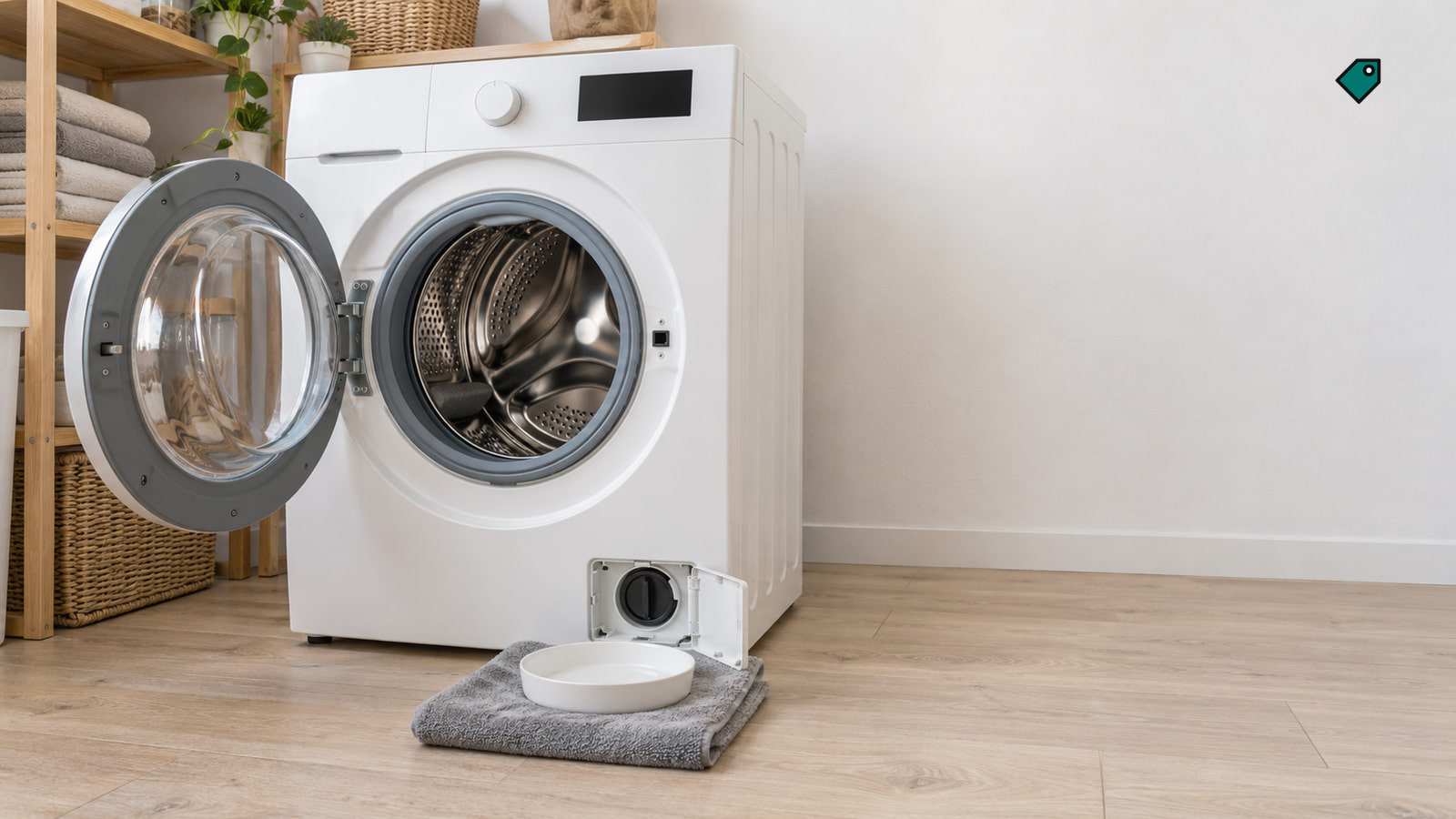
If the hose and receiving drain are clear but flow is still weak, look for a filter behind a small lower door, removable base drawer or lower access panel. Look for the twist-out cap behind that door, drawer or panel. If reaching the pump means moving the washer, removing cabinet parts or exposing electrical areas, leave it for appliance service.
Lint, coins and small objects can block the pump inlet. Water remains in the lower drain path even when the drum looks empty. After a hot wash or cleaning cycle, let that water cool before opening the cleanout.
- Switch the washer off, unplug it and keep a water-filled door closed. Spread towels under the filter opening and slide a wide, shallow pan beneath it. If there is no room for the pan or no owner access point, stop here.
- If a small drain tube sits beside the filter, release it, remove its plug and empty it into the pan. Empty the pan as often as needed, then replace the tube plug and secure the tube.
- If there is no drain tube, turn the filter cap counterclockwise only until water begins to flow. Close it when the pan fills, empty the pan and repeat until water stops coming. Then turn the filter counterclockwise and remove it.
- Lift out lint, coins and other reachable debris. Rinse the filter, wipe debris from the exposed opening and clean the filter seal. Reinstall the filter clockwise, firmly by hand, as far as it will go; close the access cover. A dry housing during the drain test confirms that it sealed.
Weak flow after cleaning the filter calls for the drain test. If water appears around the filter, stop the cycle; the washer leak checks help locate the first wet spot.
Clear the display and prove the washer drains
Once you have corrected what you found and reinstalled the filter, try one controlled drain test. Before starting the test, secure the hose in a standpipe or over a utility sink, and stop the cycle immediately if the hose moves or water leaks.
- Try Pause/Cancel. If F21 remains or the control will not accept the command, disconnect power for 5 minutes, then reconnect it. The display may clear, but drainage is the result that matters.
- Close the door firmly and select Drain & Spin. If Control Lock is lit, hold the button or button pair marked for that lock for about 3 seconds until its indicator goes off. Press Start again; the washer should begin draining.
- Watch the visible tub water fall as water leaves the hose, and make sure the standpipe or sink does not rise or overflow. Look under the filter housing for drips. The drain cycle should finish with the tub empty and F21 off.
- Run one normal load after a clear drain test. It should finish without standing water, a backed-up drain, a filter leak or returning F21.
If the control still will not start after the door, lock and power checks, record that result for service. Report a pump that hums with weak flow or stays silent during an accepted command. If the tub empties before F21 returns, report that too: the drain speed or water-level system needs diagnosis.
What the remaining repair may cost
Stop using the washer if F21 returns, the filter leaks, the drain backs up or the control cannot start the test. For a backed-up standpipe or sink, call a plumber. For a washer-side failure, call warranty service if the washer may still be covered, or an independent appliance repair shop for an out-of-warranty estimate. Give them the model and full code, whether the standpipe backs up, what the pump sounds like and whether the tub empties before F21 returns.
For a front-loader obstruction cleanout, an independent shop bills 1 to 2 hours at $100 to $150 per hour, including diagnosis and a drain test. Shops may mark parts up over retail, so the parts line on a quote can run higher.
| Quoted scope | Price | What it covers |
|---|---|---|
| Front-loader diagnostic visit | $100 to $130 | Assessment when no repair is approved. |
| Independent-shop front-loader obstruction cleanout | $100 to $300 | Diagnosis, 1 to 2 labor hours and a drain test. |
| Illustrative OEM pump replacement for select front loaders | $210 to $430, including a $110 to $130 OEM pump plus labor. | OEM assembly, diagnosis, 1 to 2 labor hours, installation and drain test. |
For this front-loader pump example, a typical installed build uses about $120 for the pump and 1.5 hours of labor, totaling about $310. Other failed parts and unusual access work can raise the bill beyond the example. Confirm which assembly fits the washer before buying it: F21 alone does not identify a failed pump. Replacement requires cabinet access and electrical work, so request an itemized repair quote.
Ask when booking whether the diagnostic fee is credited if you approve the repair; declining it can leave the visit fee payable. A qualifying manufacturing defect in the first year may have parts and labor coverage. Ordinary clog cleaning needs a coverage decision under the washer's warranty. For an older washer, compare the repair quote with the price of a new washer and the washer's condition, especially after repeated failures.
Questions after the drain check
Can I keep using the washer while F21 is showing?
Stop using it if water remains, the household drain overflows, the filter leaks or F21 returns during the test. Another load can leave laundry and water trapped behind the locked door. Resume after the drain test and one normal load finish without a backup, leak or returning code.
What if the tub empties but the door remains locked?
Let the drain routine finish and wait for the lock light to go out before gently trying the handle. If the washer is off, turn it on and wait for the lock light to go out. If it stays locked, try Pause/Cancel and the 5-minute power reset, then report the locked door and F21 to service.
How can I stop F21 from coming back?
Empty pockets, put small machine-washable garments in a mesh bag, and keep the drain hose uncrushed and secured. Clean a filter you can reach every few months or when debris builds up, and measure HE detergent for each load. Recurring F21 needs diagnosis, not another reset.
More in this category