What to measure before you buy
- Measure the porcelain bowl from the midpoint between the mounting holes to the outside front rim.
- Record the widest outside width, hole spacing, and space from the holes back to the tank, all in inches.
- About 16.5 inches points to round; about 18.5 inches points to elongated. Compare the actual seat dimensions too.
- Stop before fastening if the bolts need force, the ring lacks support, or the lid hits the tank.
The ring rests on the bowl, while its hinges attach through the holes at the back. Those are two separate fit questions: a ring can match the outline while its bolts miss the holes. We'd measure the porcelain first because an old lid's outside length and a listing's overall length use different endpoints from the bowl measurement.
Keep a note of where each tape reading starts and ends. That makes it easier to compare your bowl with a seat drawing, especially if the old seat is still attached or the bowl looks shorter than a typical elongated one.
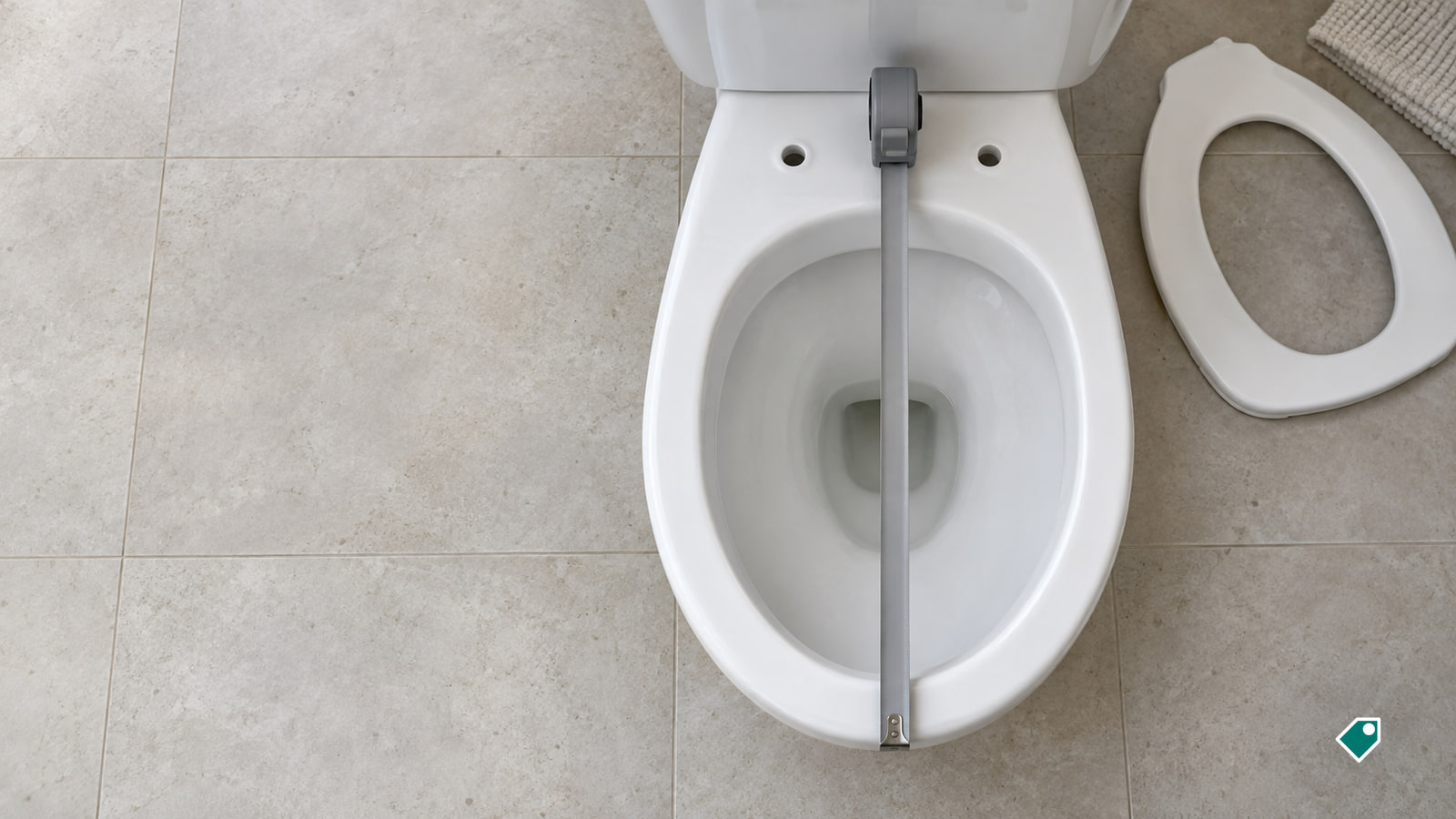
Take the four bowl measurements
Use a tape measure. If the old seat is attached, raise both the lid and ring. Gently lift the two hinge covers to see the bolt positions; the centers of the bowl holes beneath them are your reference points. A small flat screwdriver can lift a stubborn cap. Kohler's covered-hinge instructions (opens in a new tab) show this arrangement.
If the old seat hides the hole centers or the outside rim, lift it off before taking the final readings. A quick-release seat comes away at its release control; other seats must be detached at their mounting hardware. For bottom-mount hardware, hold each nut underneath, turn the bolt from above, then lift off the seat.
- For length, put the tape at the midpoint between the two mounting-hole centers. Run it straight down the middle of the bowl to the outside edge of the front porcelain rim. Write down the length in inches, with “hole centers to front rim” beside it.
- For width, measure across the widest part of the porcelain rim, outside edge to outside edge. Record the width separately. This tells you whether the new ring can cover the rim without extending beyond it; width alone does not identify the bowl shape.
- For mounting spread, measure from the center of one bowl hole to the center of the other. Record that distance in inches. If a hinge hides a center, locate the bolt shaft beneath its cover instead of measuring from the outside edges of the caps.
- For rear clearance, measure straight back from the line through the two hole centers to the nearest face of the tank. Record that distance in inches and look at the space the lid will travel through as it opens.
You should now have four labeled readings from the porcelain and its mounting holes. The separate seat replacement steps cover removal and fitting.
Measure the bowl even when you have the old lid nearby. The lid's outside length is a different measurement from hole-center-to-front-rim length, and the replacement has to match the porcelain it will sit on.
Decide whether the bowl is round or elongated
Look down at the bowl's outline and use the length you just measured. A shorter, rounded front measuring about 16.5 inches from the mounting holes to the front rim usually takes a round seat. A longer oval front measuring about 18.5 inches usually takes an elongated seat. The roughly two-inch difference makes length the main shape test; outside width is a separate coverage test.
If you read about 17 to 17.5 inches, put the tape back at the midpoint between the hole centers and measure to the outside front rim again. Then compare that reading and the outline with a dimensioned seat drawing.
A compact elongated toilet can have an elongated seating outline while the whole fixture occupies a shorter space. Use the bowl measurement to pick its seat. A square, D-shaped, or other unusual outline needs a seat whose drawing matches that outline and the mounting points.
Make sure the hinges and hardware will fit
About 5.5 inches center to center is common for mounting holes in US homes, but your measured spread governs. A seat with fixed hinges must match it; an adjustable hinge's stated spacing range must include it. Length alone cannot make bolts line up with holes that sit outside the hinge range.
Next, compare your hole-centerline-to-tank reading with the seat's rear-clearance requirement. Look at the tank face and lid path too: a tank that slopes toward the hinges can interfere as the lid opens. Seat designs use different clearance dimensions, so match the endpoints shown in the candidate's drawing. American Standard's seat fit measurements (opens in a new tab) illustrate how the holes, bowl, and tank can be measured separately.
Look beneath the back of the bowl before choosing hardware. With an ordinary bottom mount, bolts pass through the hinges and bowl and nuts secure them from below. If a skirted or one-piece bowl blocks access to those nuts, choose a seat or compatible kit that anchors through the bowl holes from above. Confirm that the package includes hardware for that mounting method before adding a separate kit.
Some hinges or mounting plates let you move the ring forward or back to center it. Use that movement for a small position mismatch. The ring keeps its shape, and its hinge spread must still include your measured spacing.
Compare your notes with the seat listing
Lay your four readings beside the seat's dimension drawing and hardware details. We'd choose a listing that defines its measurement endpoints, because “overall depth” can include parts behind the mounting-hole line. Compare a hole-center-to-front seat dimension with your bowl length; compare overall seat length separately with the space available from the tank toward the bowl's front.
- The ring outline matches the bowl's round, elongated, or specialty shape.
- The hole-center-to-front fit dimension agrees with your measured bowl length.
- The seat's width covers the widest outside rim without unwanted overhang.
- The fixed hinge spread matches your holes, or the adjustable range includes their measured spacing.
- The rear-clearance drawing leaves room for the lid to open past the tank.
- The included bolts and anchors work with the access your bowl provides.
If the listing gives only a shape name or an undefined seat depth, choose one with a dimension drawing. The bolts must enter the holes freely, the ring must sit centered on the rim, its bumpers must touch porcelain, and the lid needs a clear opening path. Many seats include mounting hardware, so read the package contents before buying bolts separately.
For an unusual bowl, put its outline and all four measurements beside a seat made for that shape. Use the toilet's model number to find a matching dimension drawing, then compare that drawing and the mounting method with the bowl.
The shape label is right, but the seat does not fit
Set the candidate seat on the bowl before fastening it. Line up the hinges, center the ring, and raise the lid through its opening path. The result you want is visible: bolts line up freely, the ring is supported by its bumpers without unwanted overhang, and the lid clears the tank.
- If the bolts miss the holes, remeasure center to center and compare that reading with the hinge's fixed spread or adjustable range. A different seat or a compatible mounting kit is needed when the hardware cannot meet the measured holes or the bowl's mounting access.
- If porcelain shows at the front or the ring extends beyond it, confirm that the tape started midway between the mounting-hole centers and ended at the outside front rim. On a seat with front-to-back adjustment, keep the mounting bolts loose, then move the hinge or plate within its stated travel and center the ring again. Confirm that the bumpers touch the porcelain and that the ring and lid clear the tank before tightening. Hold the seat in position and tighten the bolts only until the seat is secure. Open and close the ring and lid; they should move without shifting or striking the tank. If the ring outline still misses the rim, choose a different seat.
- If the ring's bumpers miss the porcelain or the lid strikes the tank, compare the bowl's width and rear clearance with the seat drawing. Open and close the ring and lid during the dry fit. Choose a seat whose ring has support and whose lid can open clear of the tank when adjustment cannot provide both.
If those checks still leave an unsupported ring, misaligned bolts, or a lid that hits the tank, the owner fit check is over. Ask the toilet or seat maker's support team for a compatible seat or mounting kit. Send your four measurements, photos from above and beneath the hinges, any legible toilet or seat model number, and the candidate seat's product number. For hardware you cannot remove or fit safely, hire a local handyman or plumber. A separately booked simple replacement carries a $75 to $200 labor or minimum-visit charge; the seat, special hardware, and difficult removal are extra.
Keep the four labeled measurements with the replacement seat's dimensions. If you buy another seat later, those readings let you compare the new drawing with the same porcelain endpoints.
Questions about replacement seats
Can I put an elongated seat on a round toilet, or the other way around?
No for ordinary seats. The usual bowl lengths differ by about two inches, leaving exposed rim or overhang even when the holes align. Hinges cannot change the ring's shape; a seat expressly made to fit both shapes is a separate option.
Is the old seat's model number enough to buy a replacement?
The seat number can identify an exact replacement, while a toilet model number identifies the porcelain fixture. Either can help you find a fit drawing, but the bowl measurements and new hardware still have to match. If neither number is legible, use the four measurements and a dimensioned listing.
More in this category